

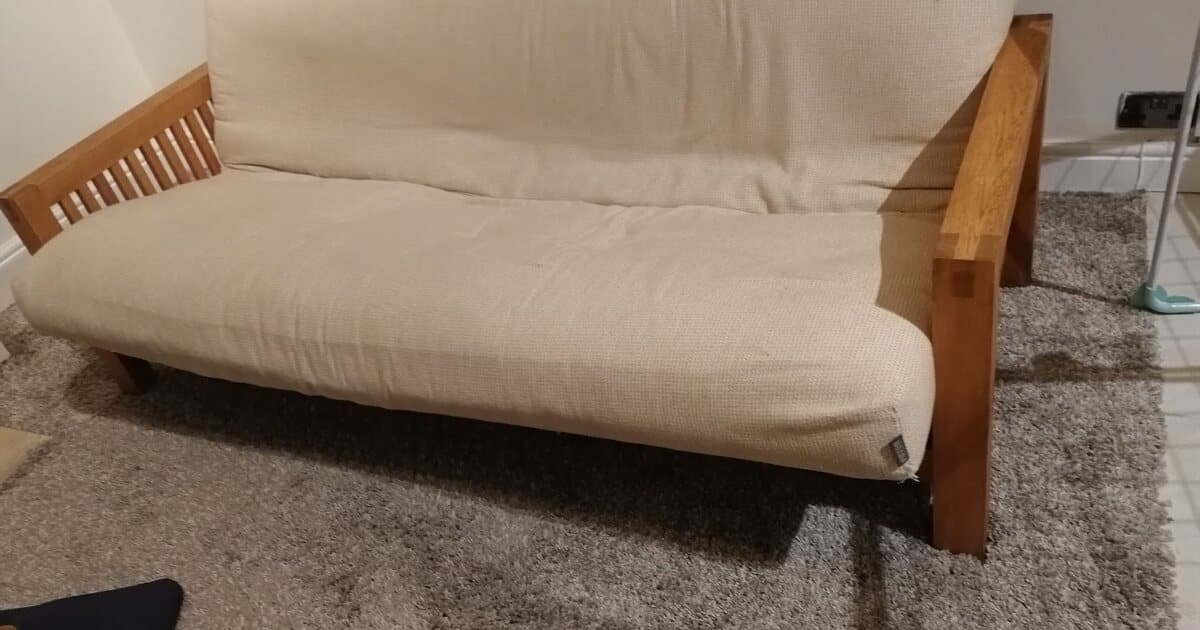
For most of the last century, an old sofa was simple. It went on the bonfire, in a skip, or to the tip, where it was crushed with everything else and buried. The rules changed over a few years, through a run of Environment Agency letters, guidance and rewrites, and the change reached householders mostly as confusion: a charity that wouldn't take the settee, a skip firm that charged extra for it, a council crew that left it on the pavement.
This guide explains what changed and why, what it means for your sofa, and what your options are on the Isle of Wight. The legal detail comes from the government's guidance on managing waste upholstered domestic seating containing POPs, last updated on 29 July 2026, and its companion guidance on reusing it.
What's actually in your sofa
For decades, UK upholstered furniture has had to resist fire. The Furniture and Furnishings (Fire Safety) Regulations 1988 set tough flammability standards, and one common way to meet them was to treat fabrics and foams with brominated flame retardants.
Some of those chemicals are now classed as persistent organic pollutants: substances that don't break down in the environment, build up in living things and travel long distances. The government guidance names decaBDE as the most common one in seating, with HBCDD, pentaBDE and tetraBDE also found. The furniture trade body FIRA notes that decaBDE was typically used in the back-coating of upholstery fabric, and was listed as a POP in 2019.
The rules followed from evidence. In November 2020, the consultancy WRc sampled 282 items of waste soft furniture for the Environment Agency, at household waste recycling centres, transfer stations, an energy-from-waste plant and a reuse warehouse. The resulting report found "a significant proportion" of domestic seating contained POPs above legal limits, according to LetsRecycle's coverage in November 2021.
282
Items of waste soft furniture sampled for the Environment Agency in November 2020
Source: WRc report, via LetsRecycle
88%
Share of the POPs flame retardants found in sofa textile covers
Source: WRc report, via LetsRecycle
29 July 2026
Date the government guidance was last updated
Source: GOV.UK
According to the same report, sofa textile covers held 88% of the POPs-classified flame retardants, rising to 94% when armchair covers were added (LetsRecycle). In other words, the problem is mostly in the fabric, not hidden away in the frame. That's why the rules care so much about covers and foam being kept together and destroyed.
Can you tell by looking? No. The guidance says operators can use handheld XRF scanners to detect bromine, which suggests POPs are likely to be present, but only with trained staff and evidence that the method works. For a householder, and for most collectors, the practical position is to assume any upholstered seat contains POPs.
What counts as upholstered domestic seating
The guidance covers any seat of a kind used in the home that has a part made of, or containing, leather, synthetic leather, fabric or foam. That applies whether it comes from a house or a business.
Covered by the rules, or not?
Covered
- Sofas, sofa beds and settees
- Armchairs and recliners, including electric ones
- Upholstered dining and kitchen chairs
- Stools and footstools
- Futons and bean bags
- Cushioned garden furniture
- Seat cushions and larger cushions
Not covered
- Mattresses and beds
- Curtains and blinds
- Scatter cushions smaller than 60 × 60 cm
- Wooden or metal chairs with no padding or fabric
- Deckchairs
- Commercial seating not used in homes
"Not covered" doesn't mean the item is chemical-free. The government warns that commercial seating, such as office or cinema seats, is at particular risk of containing POPs, and is dealt with under separate rules. Electric recliners also need care, because POPs can sit in the plastics, cables and circuit boards as well as the upholstery.
Why it can't go to landfill
The central rule is short. Waste upholstered domestic seating containing POPs must be incinerated, at an authorised municipal or hazardous waste incinerator or a cement kiln, so the chemicals are destroyed. The guidance is direct: "Landfill operators must not accept any waste upholstered domestic seating containing POPs."
It isn't classed as hazardous waste, but the chemicals have to be named on the waste transfer note whenever it changes hands between businesses.
Three practical consequences follow.
It has to be kept separate. The guidance says that if you mix POPs waste with other waste, "you must manage the whole load as POPs waste", even if the mixing dilutes it below the legal limit. A van with one sofa on top of a tonne of general rubbish has, in effect, turned the whole tonne into POPs waste.
It can't be thrown in a compactor with everything else. Bulky collection vehicles can carry seating with other bulky items only if it isn't mixed in or compacted with them and is unloaded separately. At household waste recycling centres it goes into dedicated bays, not the general waste skip.
It costs more to deal with. Burning everything at an authorised plant, with the right paperwork and separation, is more expensive than landfill. You can see that in the Isle of Wight Council's own published rates at the Lynnbottom commercial waste centre, where licensed carriers pay £450 a tonne for POPs waste against £200 a tonne for general waste (as of October 2026).
One sofa thrown on a general load turns the whole load into POPs waste. That's why a careful collector loads it last and unloads it first.
Reuse: when a sofa can still have a second life
The best thing for an old sofa is to keep being a sofa. The rules allow that, but the reuse guidance is careful about when a sofa is still a product and when it has become waste.
A sofa can be passed on as a product, not waste, only if all of these apply:
- it will be used again as seating
- the person giving it away intends it to be reused
- it needs no more than minor repair, and both sides know about the repair
- any repair needed will be done
- its use complies with the law, "for example it carries appropriate fire safety labels"
- it is stored and moved in a way that doesn't damage it.
If any of those fail, it's waste, and anyone who lets a POPs-containing item be reused without meeting all of them is, in the guidance's words, "breaking the law".
What "minor repair" means
The Environment Agency gives examples. Reattaching a broken leg is minor. Rebuilding a structurally collapsed sofa, which means stripping the upholstery, lining, foam and wadding, is not. Cosmetic improvements to a sofa that already works don't count against it.
So a sound sofa with a wobbly leg and a label can be reused. A sofa with a broken frame, torn covers and foam spilling out is waste, however much life you think it has in it.
The trouble with reupholstering
Reupholstering a sofa you're keeping is fine, but the old foam and fabric you strip off are POPs waste and must go for incineration. Anyone refurbishing waste sofas as a business needs a permit or exemption, must capture the dust and offcuts, and must remove all foam and fabric that may contain POPs, even the parts that look fine. It's a reasonable rule, but it means a cheap secondhand sofa for re-covering is harder to come by than it used to be.
The labels: what they tell you and what they don't
Lift the seat cushions or look underneath a sofa and you'll usually find a permanent label sewn in. This is the fire safety label required under the 1988 regulations. It shows the item was made to meet UK furniture fire standards.
It doesn't tell you whether the sofa contains POPs. The government's guidance doesn't treat the fire label as a POPs indicator, and a sofa made to meet the fire standards could have done so with or without these particular chemicals.
What the label does decide is whether the sofa can lawfully be passed on. Without it, a sofa fails the "complies with the law" test in the reuse guidance, and on the Isle of Wight it gets turned away:
- the council's free reuse collection requires "current fire safety regulation labels" on sofas and armchairs, and items refused on the day are referred to the paid bulky service
- the "Think Before You Throw" reuse points at Lynnbottom and Afton Marsh need sofas, armchairs and settees to have the fire safety label attached
- Mountbatten's donation guidance says fabric furniture needs a fire safety label, and it doesn't take broken items.
What happens to a sofa on the Isle of Wight
There are four routes for an unwanted sofa on the Island, and they suit different sofas.
Reuse, free. If it's sound and labelled, book the council's free reuse collection online or on 01983 823777, or contact a furniture charity. The council's reuse networks page lists Storeroom2010 in Cowes, which can collect, and the British Heart Foundation, whose Newport home store at 18a High Street offers free collection of furniture. Each will check the sofa against its own standards. The reuse guidance notes that collectors who check items before accepting them are handling products, not waste.
The tip. Lynnbottom and Afton Marsh both accept household furnishings, and both have reuse points. You'll need a booking, a car or permitted van big enough, and two people, because staff can't help unload. Our guide to the Island's tips covers booking and permits.
Council bulky collection. The council's bulky waste service takes settees, sofa beds and armchairs among up to four items for £62 (as of October 2026). A three-piece suite counts as three items, and everything has to be at the kerb by 7am. Our bulky waste guide has the details and collection days.
Private collection. A registered waste carrier collects from inside the house, should keep the seating apart from other waste, and takes it to a facility that can accept it. This is the route for a sofa that's upstairs, stuck in a conservatory, part of a bigger clear-out, or simply too heavy for you to move.
Where do the Island's waste sofas end up? The council doesn't say on its website. The Island has its own energy recovery facility at Forest Park in Newport, which burns general waste, but we haven't seen the council publish where upholstered seating goes, so we won't guess.
Which route fits your sofa?
Sound, clean, labelled, and you can wait for a collection
Council reuse collection or a furniture charityFree, and the sofa keeps being a sofa.
Worn out but downstairs, and you can get it to the kerb
Council bulky collectionUse the other slots for other items.
Label cut off, or frame broken
Bulky collection, the tip or a private collectionIt is waste now; reuse routes will refuse it.
Upstairs, heavy, or part of a bigger clear-out
Private collectionCarried out for you, from any room.
What not to do
Don't put it in a skip with other waste without asking the skip firm first. Under the mixing rule, a sofa in a mixed skip can turn the whole load into POPs waste, so skip firms set their own rules for upholstered seating.
Don't burn it in the garden. Burning foam and treated fabric releases smoke you don't want anywhere near you, and the point of the rules is that these chemicals are destroyed at controlled high temperatures, not in a bonfire.
Don't cut it up for the wheelie bin. Chopping a sofa into pieces spreads foam and fabric dust, and the guidance requires any shredding to happen indoors with dust controls for exactly that reason.
Don't hand it to an unregistered collector. If a sofa you paid someone to take turns up in a lay-by, you can be fined too: up to £600 for failing in your household waste duty of care, according to GOV.UK. Check the collector on the Environment Agency's public register and ask for a receipt.
What to ask any collector, us included
Because the rules are recent and fairly technical, it's reasonable to ask a collector how they'll handle a sofa. A good answer covers:
- their waste carrier registration number, which you can check on the public register (our guide to checking a waste carrier licence shows how)
- whether the seating will be kept apart from other waste in the van
- where it's going, and that the site can accept POPs waste
- whether any of it might be reused, and what checks they make
- a receipt or waste transfer note.
We're a licensed waste carrier based in Newport, collecting across the Island. Our furniture removal service covers single sofas and full suites, and we set aside what can be donated. Mattresses fall outside the POPs rules but still need their own route, which our mattress disposal page explains. For a whole room or a whole property, see house clearance or our general rubbish removal service.
Sofa that won't fit through the door the other way?
We'll carry it out from wherever it is, set aside anything that can be reused, and take the rest to a licensed facility. Tell us what's going and you'll get a price before anything is booked.
The POPs rules have been rewritten several times since 2022, most recently in July 2026, so check the government guidance for the current position before relying on any detail here. The principle hasn't changed: the chemicals in old upholstery are meant to be destroyed, not buried, and the best sofa is still the one someone else sits on.
Want it gone without the lifting?
Tell us what needs to go and we'll come back with a price. Anywhere on the Isle of Wight.

Written by
Michael Shaw
Michael looks after marketing at Isle of Wight Rubbish Removal and has worked in rubbish removal full-time in the past.
About Isle of Wight Rubbish Removal